

All Posts
A Journey into the Animal World: Educational Games to Develop Your Child's Skills
Childhood is a time of great exploration, where everything around a child is a mystery waiting to be solved and an adventure waiting to begin. Of all the creatures and subjects that capture children's attention and fascinate their minds, the animal kingdom remains the most beloved and enchanting of all.
Combining children's natural love of animals with educational toys is not just a way to pass the time; it's a smart parenting strategy that contributes to building a child's character and developing their mental, physical, and social skills. In this article, we'll take you on a fun journey to explore how animal toys can become magical tools for developing your child's skills.
Why do children love animal toys?
From their earliest months, children show an innate curiosity about living beings. Their eyes are drawn to the movements of pets, and their ears are delighted by their sounds. This innate love stems from several reasons:
Similarity and emotional connection: Children see animals (especially young ones) as innocent and friendly beings who resemble them in their simplicity.
Visual and auditory variety: Animals offer an endless array of colors, shapes, sounds, and movements that stimulate a child's senses and spark their wonder.
Humanization in children's literature: Stories and cartoons that make animals talk and act like humans build a strong emotional bridge between children and these creatures, making animal figurines and toys an extension of their favorite characters.
How do animal toys make learning more fun?
Traditional rote learning can quickly bore children. This is where animal toys come in, simplifying complex concepts and transforming them into visual and interactive enjoyment:
Converting the abstract to the concrete: Instead of explaining the concept of "camouflage and self-preservation" theoretically, a model of a chameleon can be used to demonstrate how it changes color in a green or brown environment.
Gamification: When children discover animal characteristics through solving puzzles or sorting cards, their dopamine, the hormone associated with pleasure and achievement, is released, helping them retain the information for longer with less effort. Developing Imagination and Creativity Through Imaginative Play
Imaginative play, or "role-playing," is the laboratory where children develop their intellectual skills. Animal games provide rich material for this type of play:
Impersonation: When a child pretends to be a veterinarian treating an injured dog, or a lion protecting its forest, they construct complex scenarios and stories from their imagination.
Creative Problem-Solving: During play, a child might encounter an "imaginary problem," such as a sheep figurine stuck on a mountain. They then begin searching for creative solutions to rescue it using blocks or other tools, thus developing their intellectual flexibility.
Learning Animal Names and Habitats Interactively
Knowing an animal isn't limited to its name; it extends to understanding the environment and ecosystem it lives in. You can facilitate this interactive learning through the following activities:
Interactive Environment Mats: Use a mat depicting (sea, desert, forest, polar ice) and ask the child to place each animal figurine in its correct environment (for example: the penguin in the polar ice, the camel in the desert). Matching and Memory Games: Matching an animal's picture with its tracks (footprints), or matching an animal with its favorite food (rabbit with carrots, monkey with bananas). These activities develop logical reasoning and visual observation.
How do animal games help develop motor skills?
A child's motor development is divided into fine motor skills and gross motor skills, and animal games serve both purposes perfectly:
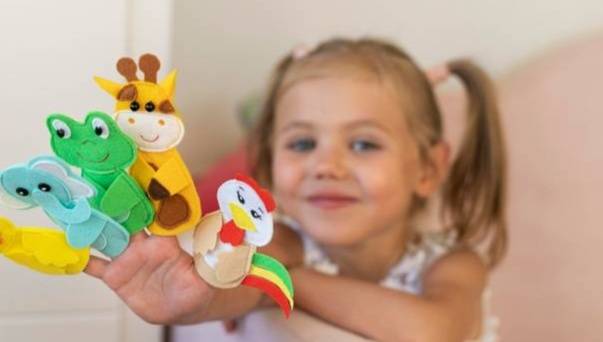
Fine Motor Skills: Assembling giraffe-shaped blocks, catching and arranging small animal figurines, or using tweezers to move small insect figurines are all activities that strengthen finger and hand muscles and prepare the child for writing in the future.
Gross Motor Skills: Encouraging the child to imitate animal movements (jumping like a kangaroo, crawling like a snake, walking like a bear) enhances their physical balance, flexibility, and overall motor coordination in a fun and engaging way.
The Role of Animal Games in Enhancing Focus and Attention
In the age of fast-paced screens, distraction has become a major challenge. Classic animal games help retrain a child's mind to focus:
Sorting and sorting games: Sorting animals by size (from largest to smallest) or by body covering (fur, feathers, scales). This requires keen observation and strong visual concentration.
Building animal enclosures: Using blocks to build an enclosed space for each animal requires planning, patience, and composure—essential mental skills for developing focus and attention for longer periods.
Encouraging exploration and questioning: The animal world is full of wonders that spark a child's cognitive curiosity and encourage them to ask fundamental questions (Why? How? Where?):
Suggesting curious questions: "Why does a giraffe have a long neck?", "How can fish breathe underwater?". These questions are the beginning of scientific thinking and the search for answers.
Home exploration experiments: You can freeze some plastic animal figurines in ice cube trays and ask your child to use warm water and salt to "rescue the Arctic animals." This allows them to learn exploration skills and the principles of ice thawing practically. Animal Games and Developing Communication and Group Play Skills
When children play with animal toys, they build a shared language that contributes to their social and emotional development:
Negotiation and Role Sharing: “I’ll be the lion and you’ll be the tiger. Let’s build a house together.” This simple dialogue teaches children negotiation, sharing, and amicable conflict resolution skills.
Developing Vocabulary: By naming animals and describing their movements, sounds, and feelings while playing, children acquire new vocabulary and expressive language, increasing their self-confidence when speaking with others.
Choosing the Right Toy for Your Child’s Age and Interests